Sunday Camping Eggs with Bacon, Greens & Sauerkraut
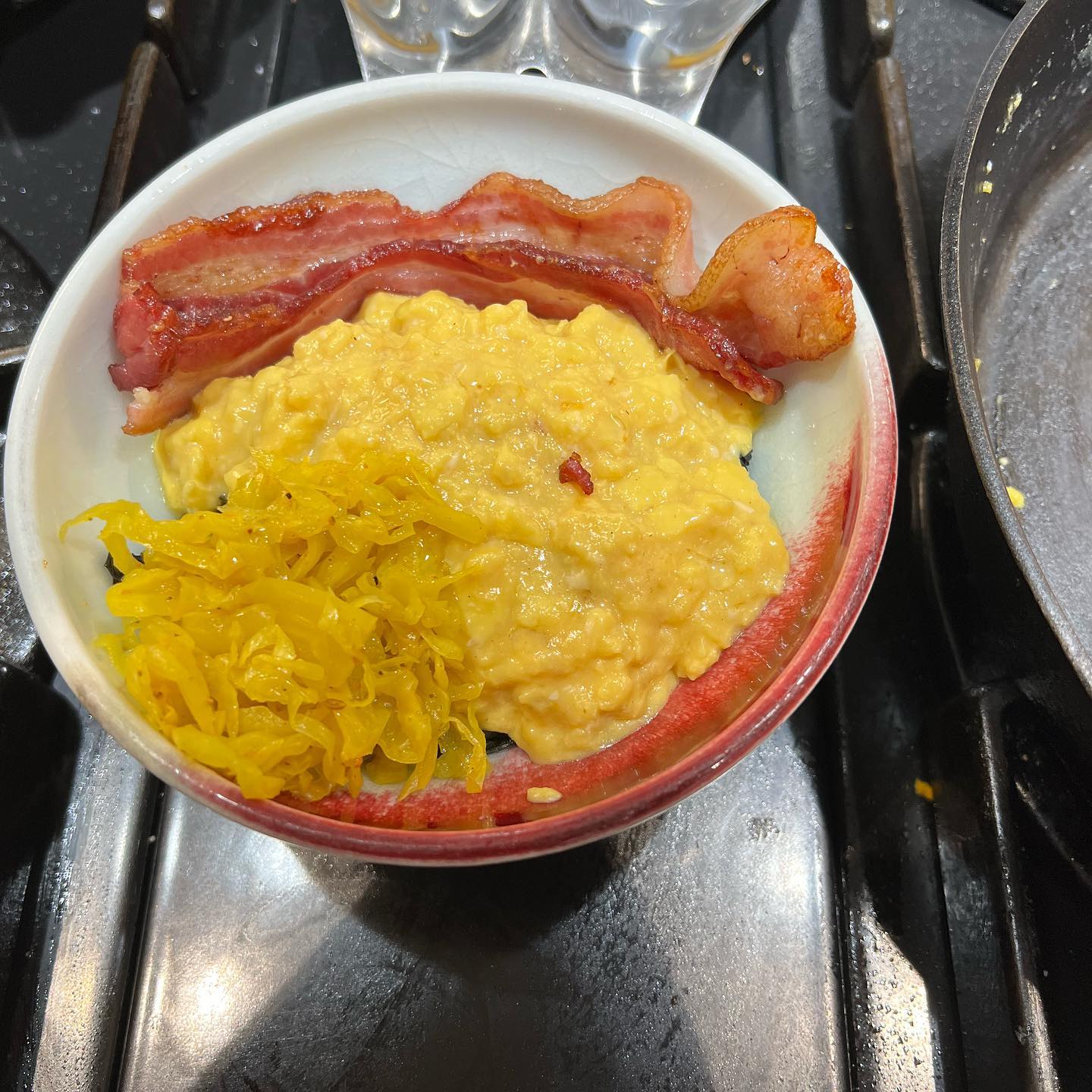
Slow-scrambled eggs turn silky in the bacon drippings, with crisp-edged strips alongside and warm greens underneath. A generous spoonful of sauerkraut cuts through the richness—a simple Sunday breakfast that works just as well over a camp stove.
By Jonathan Katzman · Cooked and photographed · Recipe updated
Serves: 4 servings
Tags: gluten-free, paleo, dairy-free, nut-free
Cold-Oven Cast-Iron Bacon
Starting cold gives the fat time to render before the bacon's edges brown. The drippings then season the eggs without another added fat.
Ingredients
- 0.5 lb sliced bacon, gluten-free and made without added sugar
Instructions
- Arrange the bacon in a single layer in a cold, large cast-iron skillet, ideally 12 inches.
- Put the skillet in a cold oven and set it to 350°F convection. Begin checking after 15 minutes; cook until the fat is rendered and the edges are golden, usually 15–20 minutes, allowing longer for thick bacon or a slow-heating oven.
- Transfer the bacon to a rack or plate and keep in a warm toaster oven at about 170°F while cooking the eggs.
- Leave the rendered fat and browned bacon flecks in the skillet. Set the skillet off heat until it is no longer fiercely hot before adding the eggs.
Notes
- For camping, start the bacon in the skillet with water about 1/4 inch deep. Cook over high heat until the water evaporates, then immediately reduce to a low sizzle and turn the bacon as needed until browned. Do not add fat.
- If the bacon renders an unusually deep pool of fat, reserve the excess in a heatproof container, leaving about 2–3 tablespoons for the eggs.
Very-Low-Heat Scrambled Eggs
Gentle heat and frequent scraping produce tender, glossy curds rather than a browned scramble. Cooling the cast iron after the bacon is essential because it holds substantial heat.
Ingredients
- 10 large eggs
- 2–3 tablespoons rendered bacon fat from the bacon component, already in the skillet
- to taste fine sea salt
- to taste freshly ground black pepper
Instructions
- Whisk the eggs until the whites and yolks are completely blended. Add only a small pinch of salt; the bacon fat and sauerkraut already bring salt.
- With the bacon skillet cooled enough that the eggs will not sizzle on contact, add the eggs and place over the lowest heat.
- Stir frequently with a silicone spatula or flat wooden spoon, scraping the bottom and corners and folding the thickening eggs into the still-liquid mixture.
- Cook slowly for about 12–15 minutes. If curds form rapidly or the bottom begins to set firmly, lift the skillet off the burner and continue stirring before returning it to low heat.
- When the eggs form soft, glossy curds with no loose raw egg pooling between them, remove from heat and immediately spoon onto the prepared greens. Taste and finish with salt and pepper.
Notes
- Use pasteurized eggs for anyone at higher risk from undercooked eggs. For fully cooked egg safety, bring the scramble to 160°F; it will be firmer than a very soft scramble.
- Do not hold the finished eggs in the cast-iron skillet: residual heat will continue cooking them.
Warm Spinach Base
Spinach provides a tender, earthy base without competing with the bacon. Draining it well keeps the eggs from becoming watery.
Ingredients
- 1 lb spinach, washed and tough stems removed
- 2 tablespoons water
- to taste fine sea salt
Instructions
- Place the water and spinach in a large saucepan over medium heat, adding the spinach in batches if necessary.
- Cover briefly, then turn with tongs until just wilted and still green, about 4–6 minutes.
- Drain thoroughly and press out excess liquid lightly. Season sparingly with salt and keep warm.
- Divide among four warm, shallow bowls just before the eggs finish.
Notes
- Alternatively, use about 2 cups of leftover braised greens. Reheat with a splash of water until steaming hot throughout, then drain excess braising liquid before plating.
Sauerkraut Finish
Cool, crunchy sauerkraut supplies the acid that balances the eggs and bacon. Keeping it separate until serving preserves its texture.
Ingredients
- 1 cup prepared sauerkraut of choice, gluten-free and without added sugar
Instructions
- Lift the sauerkraut from its brine and let excess liquid drain without squeezing it dry.
- Serve about 1/4 cup alongside each portion of eggs, leaving the brine behind so it does not flood the bowl.
Overall Timing / Workflow
The greens and sauerkraut can be prepared while the bacon cooks, leaving full attention for the slow scramble.
Instructions
- 0:00 — Put the bacon in the cold skillet and cold oven; set to 350°F convection.
- 0:05 — Wash the spinach, drain the sauerkraut, and whisk the eggs.
- 0:15 — Check the bacon and cook the spinach in a separate saucepan.
- When the bacon is ready, transfer it to the warm toaster oven. Allow the skillet to cool off heat for several minutes.
- Scramble the eggs over very low heat for about 15 minutes, keeping the spinach warm.
- As the eggs approach doneness, put the greens into warm bowls. Add the eggs, bacon, and sauerkraut and serve immediately.
Notes
- For a single-burner campsite, heat cooked greens first and keep covered, then cook the bacon using the water-start method. Keep the bacon covered while scrambling the eggs.
Plating
A warm bowl supports the soft scramble, while keeping bacon and sauerkraut alongside preserves their contrasting textures.
Instructions
- Spread warm, well-drained greens across the bottom of each shallow bowl.
- Spoon the eggs over the greens in a soft mound.
- Lay the bacon along one edge and add a generous tuft of drained sauerkraut on the other side.
- Serve immediately, without stirring the sauerkraut into the eggs.
Leftover Path
Separate storage prevents sauerkraut brine from soaking the eggs and bacon. Gentle reheating limits further tightening of the egg curds.
Instructions
- Refrigerate eggs, bacon, and greens in separate covered containers within 2 hours of cooking, or within 1 hour if the outdoor temperature is above 90°F. Keep sauerkraut separately refrigerated.
- Use the cooked eggs, bacon, and greens within 3–4 days.
- Reheat eggs and greens gently in a covered pan with a small splash of water until they reach 165°F; the eggs will be firmer than when freshly cooked.
- Re-crisp bacon in a 350°F oven for 5–8 minutes, then serve with fresh portions of cold sauerkraut.
Notes
- At camp, store leftovers only if a cooler can reliably maintain 40°F or below.