Greens Sausage with Braised Red Cabbage and Squash-Miso Mash
A juicy greens sausage sits between tangy braised red cabbage and silky butternut squash enriched with honey nut squash miso. The cabbage cuts through the richness, while the miso gives the sweet squash a savory depth—a simple, satisfying winter plate.
By Jonathan Katzman · Cooked and photographed · Recipe updated
Serves: 4 servings
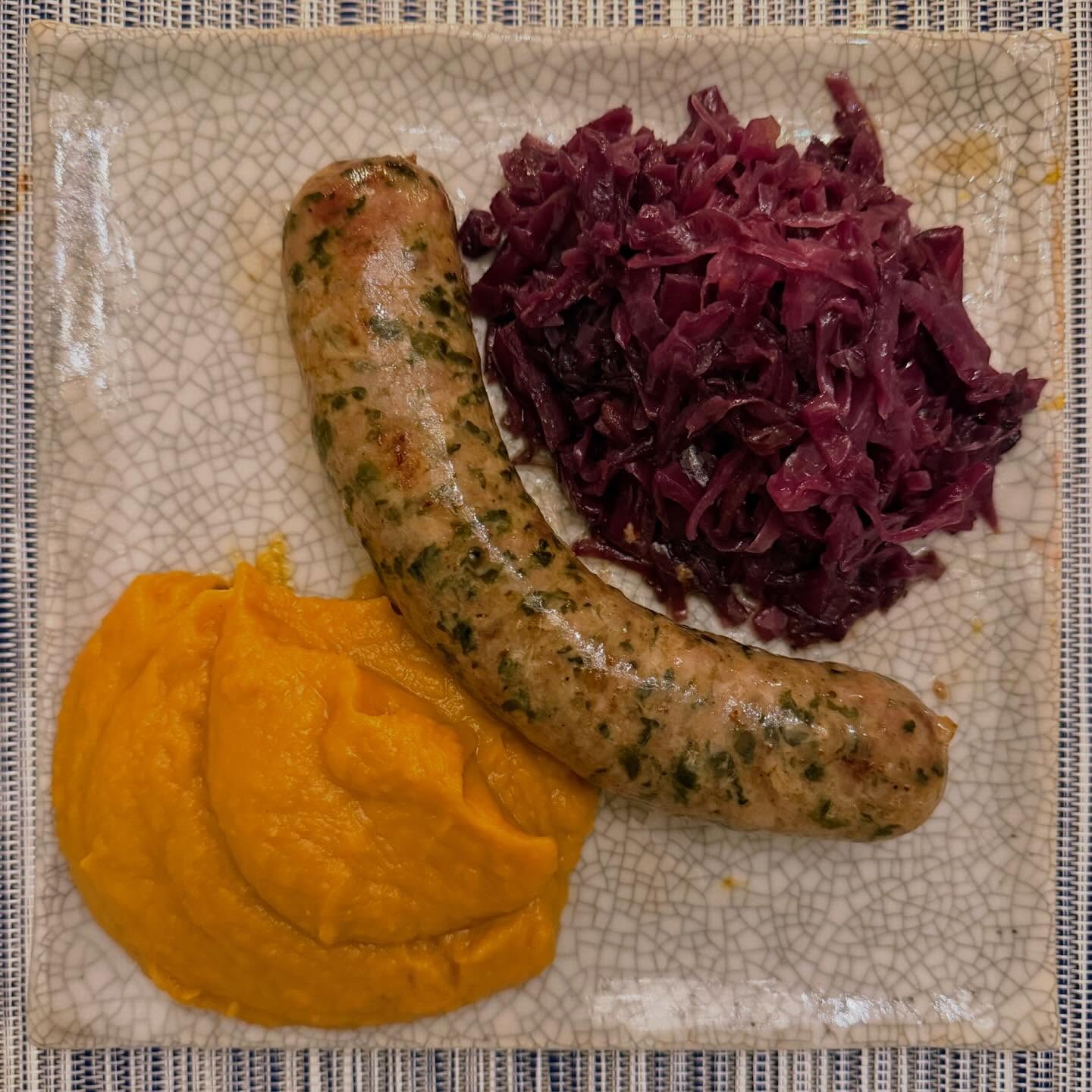
Gently Cooked and Browned Greens Sausage
A shallow covered simmer cooks the sausage gently before a brief browning step, keeping the filling juicy and the casing intact.
Ingredients
- 4 large links Fatted Calf greens sausage, about 1½–2 lb total
- 1 tbsp ghee
- ½ cup water, plus more as needed
Instructions
- Arrange the sausages in a wide skillet in a single layer. Add the water, cover, and bring to a gentle simmer over medium-low heat.
- Cook gently for 10–15 minutes, turning once. Keep the liquid at a quiet simmer rather than a boil; add a splash of water if the pan dries before the sausages are nearly cooked.
- Uncover and let the remaining water evaporate. Add the ghee and cook over medium heat, turning occasionally, until the casings are glossy and lightly golden, about 5–8 minutes.
- Check the center of a link with an instant-read thermometer: fresh pork sausage should reach 160°F; sausage containing poultry should reach 165°F. Follow any product-specific cooking instructions.
- Rest for 3 minutes and serve whole.
Notes
- Do not prick the casings; gentle heat helps prevent splitting and loss of juices.
- If the links are sold fully cooked, warm them gently before browning rather than following the raw-sausage cooking time.
Cider-Braised Red Cabbage
Slow, covered cooking softens the cabbage without turning it to mush. Cider vinegar brightens both its flavor and its purple color.
Ingredients
- 1 small head red cabbage, about 1½ lb, cored and sliced into ¼-inch ribbons
- 1 small yellow onion, thinly sliced
- 2 tbsp olive oil
- 3 tbsp apple cider vinegar, divided
- ½ cup water, plus more as needed
- ¾ tsp kosher salt, plus more to taste
- ¼ tsp freshly ground black pepper
Instructions
- Heat the olive oil in a heavy pot over medium-low heat. Add the onion and cook for 6–8 minutes, stirring, until softened but not browned.
- Add the cabbage and salt. Toss for 3–4 minutes until the cabbage begins to wilt.
- Add 2 tablespoons of the vinegar and the water. Cover and braise over low heat for 30–40 minutes, stirring every 10 minutes. Add small splashes of water if the bottom starts to catch.
- When the ribbons are tender but still distinct, uncover and simmer until the liquid lightly coats the cabbage rather than pooling beneath it.
- Add the pepper and the remaining vinegar to taste. Adjust the salt; the cabbage should be pleasantly tangy against the sweet squash.
Notes
- The cabbage can be made a day ahead; reheat covered with a splash of water, then refresh the acidity before serving.
Butternut Squash Mash with Honey Nut Squash Miso
Roasting concentrates the squash so the mash stays thick rather than watery. Squash miso adds salt and fermented depth without obscuring its natural sweetness.
Ingredients
- 1 large butternut squash, about 3 lb, halved lengthwise and seeded
- 1 tbsp olive oil
- 2 tbsp unsalted butter
- 2 tbsp Shared Cultures honey nut squash miso, plus more to taste
- 2–4 tbsp hot water, only as needed
- to taste kosher salt
Instructions
- Heat the oven to 400°F. Rub the cut faces of the squash with olive oil and place cut-side down on a parchment-lined rimmed baking sheet.
- Roast for 45–60 minutes, until a knife passes easily through the thickest section and the flesh is completely soft.
- Let cool just enough to handle, then scoop the flesh into a food processor, leaving the skin behind.
- Add the butter and 2 tablespoons of miso. Process until smooth, scraping down the bowl. Add hot water a tablespoon at a time only if needed to achieve a thick, spoonable mash.
- Taste before adding salt or more miso. Transfer to a saucepan and keep warm over very low heat, stirring frequently and avoiding a hard boil.
Notes
- Miso salinity varies considerably; start with the measured amount and adjust after blending.
- For a hand-mashed version, mash the very soft flesh thoroughly before beating in the butter and miso; the texture will be more rustic.
Overall Timing / Workflow
The cabbage and squash cook largely unattended and hold well, leaving the final minutes free for the sausage.
Instructions
- 0:00 — Heat the oven to 400°F, prepare the squash, and put it in to roast.
- 0:10 — Slice the onion and cabbage, then start the braise.
- 0:40 — Check the squash and cabbage. Continue cooking until each is fully tender.
- About 25 minutes before serving, start the sausages in their covered skillet.
- While the sausages cook, blend the squash with butter and miso. Hold over very low heat and finish the cabbage's seasoning.
- Brown and temperature-check the sausages, rest briefly, and plate everything hot.
Plating
Keeping the three components distinct preserves the contrast between smooth squash, tender cabbage, and the lightly browned sausage.
Instructions
- Spoon a generous oval of squash mash onto one side of each warm plate and sweep it lightly with the back of a spoon.
- Set a mound of cabbage opposite the mash, leaving excess braising liquid in the pot.
- Lay one whole sausage across the center, touching the edge of the squash. Serve without an additional sauce or garnish.
Leftover Path
Separate storage makes it easier to reheat the sausage without drying it out and loosen the mash without watering down the cabbage.
Instructions
- Refrigerate the three components separately in covered containers within 2 hours of cooking. Use within 3–4 days.
- Reheat the cabbage covered over low heat with a splash of water. Warm the squash separately, stirring in a little water if it has thickened.
- Reheat the sausage in a covered skillet with a small splash of water until it reaches 165°F throughout; uncover briefly to dry the casing.
- For a different presentation, slice the reheated sausage and serve over the warm mash with the cabbage alongside.