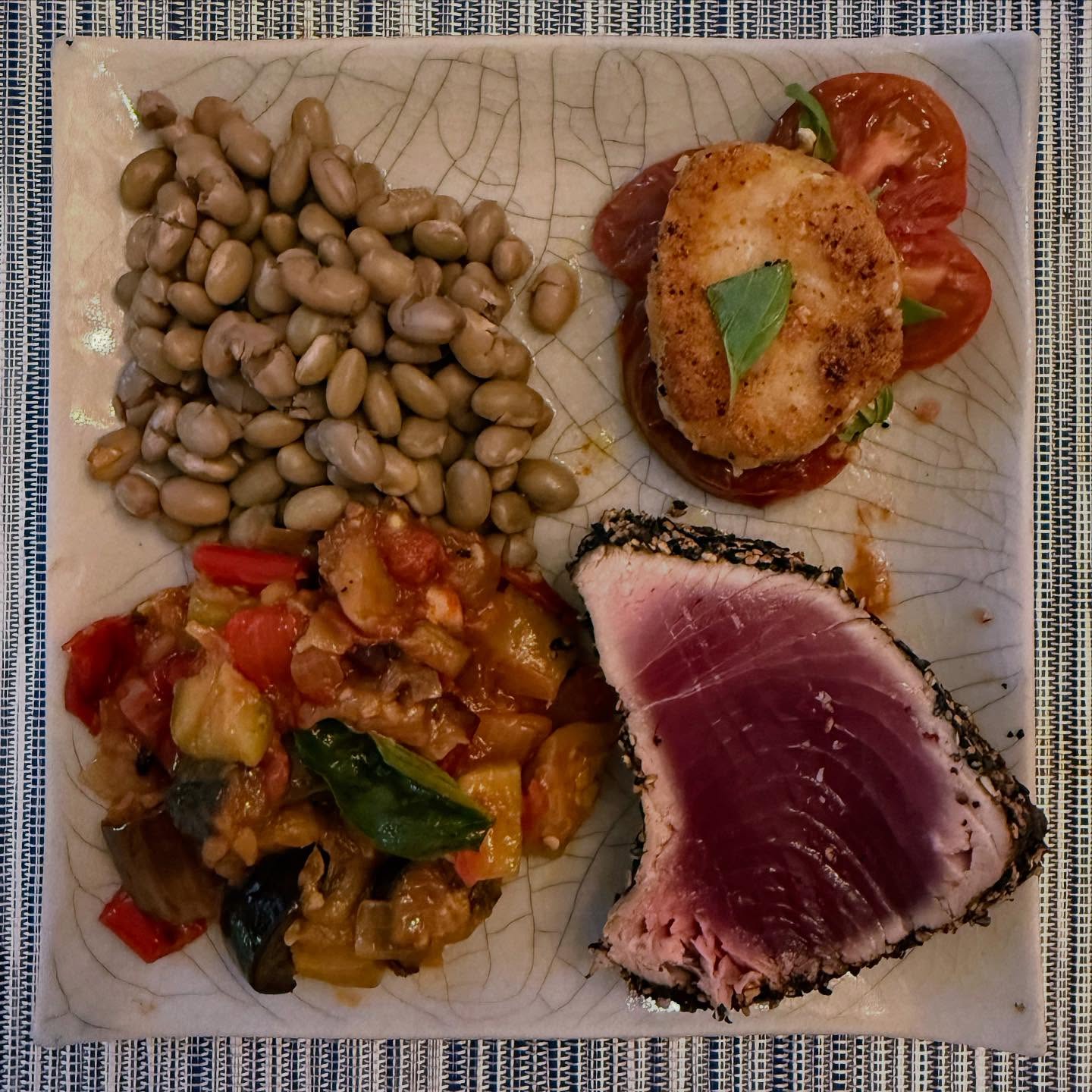
Sesame-Crusted Bluefin Tuna with Ratatouille, Fresh Shelling Beans, and Fried Fish Dumplings over Cherokee Purple Tomatoes
Rare bluefin tuna gets a nutty sesame crust alongside soft, olive-oil-rich ratatouille and tender fresh shelling beans. A crisp fish dumpling sits over slow-roasted Cherokee Purple tomatoes, whose concentrated juices tie this late-summer plate together.
By Jonathan Katzman · Cooked and photographed · Recipe updated
Serves: 4 servings
Tags: gluten-free, nut-free, pescatarian
Sesame-Crusted Seared Bluefin Tuna
A short, hot sear toasts the sesame while leaving the center cool and ruby-red. Keeping the seasoning restrained lets the tuna and summer vegetables carry the plate.
Ingredients
- 1¼ lb bluefin tuna loin, about 1½–2 inches thick, suitable for serving raw
- 2 tablespoons black sesame seeds
- 2 tablespoons white sesame seeds
- ½ teaspoon fine sea salt
- 1½ tablespoons ghee
- ½ lemon, cut into wedges for serving
Instructions
- Keep the tuna refrigerated until the other components are nearly ready. Pat thoroughly dry and season with salt.
- Combine the sesame seeds on a plate and press them firmly onto the broad faces and sides of the tuna.
- Heat the ghee in a heavy skillet over medium-high heat until shimmering. Sear the broad faces for 45–60 seconds each, then briefly sear the edges for 15–20 seconds each. The crust should smell toasted, not scorched, with only a narrow opaque band beneath it.
- Rest on a clean board for 2–3 minutes, then use a very sharp knife to cut across the grain into four substantial portions or thick slices. Serve with lemon wedges on the side.
Notes
- This method deliberately leaves the center raw; it is not a pathogen-killing cook. Buy from a trusted supplier and confirm suitability for raw service. For a fully cooked version, cook to 145°F at the center; pregnant, older, immunocompromised, and very young diners should avoid raw fish.
Late-Summer Ratatouille
Roasting the eggplant, squash, and pepper separately from the tomato base prevents a watery stew. Folding them together at the end gives tender vegetables with recognizable shapes.
Ingredients
- 1 medium eggplant, about 12 ounces, cut into ¾-inch pieces
- 2 small zucchini or summer squash, cut into ¾-inch pieces
- 1 red bell pepper, cut into ¾-inch pieces
- 1 small yellow onion, diced
- 3 cloves garlic, thinly sliced
- 1 lb ripe tomatoes, chopped with their juices
- 5 tablespoons extra-virgin olive oil, divided
- 3 sprigs thyme
- ¼ cup loosely packed basil leaves, torn
- 1–2 teaspoons red wine vinegar
- 1 teaspoon fine sea salt, divided, plus more to taste
- ¼ teaspoon freshly ground black pepper
Instructions
- Heat the oven to 425°F. Toss the eggplant, squash, and pepper with 3 tablespoons olive oil and ½ teaspoon salt. Spread across two sheet pans without crowding.
- Roast for 25–30 minutes, turning once, until tender with lightly browned edges.
- Meanwhile, warm the remaining olive oil in a wide saucepan over medium-low heat. Add the onion and remaining ½ teaspoon salt; soften for 8–10 minutes without deeply browning. Add the garlic and cook for 1 minute.
- Add the tomatoes and thyme. Simmer uncovered for 15–20 minutes, stirring occasionally, until the tomatoes collapse and the juices thicken.
- Fold in the roasted vegetables and simmer gently for 5 minutes. Remove the thyme stems, then add the basil, pepper, and enough vinegar to brighten the vegetables without making them sharply sour.
Notes
- Ratatouille can be made a day ahead and is excellent served warm rather than piping hot.
Fresh Shelling Beans with Olive Oil and Bay
Fresh beans need no soaking and become creamy with a gentle simmer. A little cooking liquor and olive oil keep them moist without obscuring their delicate flavor.
Ingredients
- 3 cups fresh shelled cranberry beans, from roughly 2½–3 pounds in pods
- 4 cups water, plus more as needed
- 2 cloves garlic, lightly crushed
- 1 bay leaf
- 2 tablespoons extra-virgin olive oil
- ¾ teaspoon fine sea salt, plus more to taste
- 1 teaspoon lemon juice
Instructions
- Put the beans, water, garlic, bay leaf, and salt in a saucepan; the water should cover the beans by about 1 inch.
- Bring to a boil, then immediately reduce to a gentle simmer. Cook partially covered for 25–45 minutes, adding hot water as needed to keep the beans submerged.
- Begin tasting at 25 minutes. The beans are done when creamy all the way through, with no chalky center and mostly intact skins.
- Discard the bay leaf and garlic. Drain off excess liquid, leaving about ¼ cup in the pan. Fold in the olive oil and lemon juice, adjust the salt, and keep warm.
Notes
- Fresh cannellini or other pale shelling beans also work; maturity affects cooking time more than variety.
Slow-Roasted Cherokee Purple Tomatoes
Thick slices retain enough structure to support the dumpling while slow roasting concentrates their sweet, savory juices.
Ingredients
- 3 large Cherokee Purple tomatoes, about 1½ pounds
- 2 tablespoons extra-virgin olive oil
- ½ teaspoon fine sea salt
- ¼ teaspoon freshly ground black pepper
- 8–12 small basil leaves
Instructions
- Heat the oven to 300°F. Core the tomatoes and cut crosswise into ½-inch-thick slices.
- Arrange in a lightly oiled shallow baking dish with minimal overlap. Drizzle with the remaining olive oil and season with salt and pepper.
- Roast for 60–75 minutes, until softened and slightly slumped with concentrated juices, but not dried or collapsed into sauce.
- Let stand until warm. Reserve the pan juices for plating and add the basil only when serving.
Notes
- These can roast first and wait at room temperature for up to 1 hour while the oven is raised for the ratatouille.
Golden Fried Fish Dumplings
Cold fish processed with egg white forms a cohesive, springy dumpling without a dough wrapper. A thin cassava coating gives a golden shell while the interior stays moist.
Ingredients
- 12 oz boneless, skinless rockfish or lingcod, very cold and cut into chunks
- 1 large egg white
- 1 tablespoon ice water, plus 1 teaspoon if needed
- 1 teaspoon finely grated lemon zest
- ½ teaspoon fine sea salt
- ⅛ teaspoon white pepper
- 3 tablespoons cassava flour, for a light coating
- 4 tablespoons ghee, for shallow pan-frying
Instructions
- Pat the fish dry. Pulse with the salt in a food processor until finely chopped and tacky. Add the egg white, 1 tablespoon ice water, lemon zest, and white pepper; pulse briefly until cohesive, stopping before the mixture warms. Add the extra teaspoon of water only if the mixture is too stiff to shape.
- With damp hands, form four oval dumplings about ¾ inch thick. Set on parchment and refrigerate for 20 minutes to firm.
- Dust the dumplings lightly with cassava flour immediately before frying, brushing away excess.
- Heat the ghee in a skillet over medium heat. Add the dumplings and cook for 4–5 minutes per side, adjusting the heat so the coating turns golden rather than dark brown.
- Check that the centers reach 145°F. Transfer to a rack and serve promptly over the roasted tomatoes.
Notes
- Keep the fish and equipment cold to preserve a tender, cohesive texture. If the crust browns before the center is cooked, finish in a 350°F oven until the center reaches 145°F.
Overall Timing / Workflow
The vegetables and beans tolerate holding, leaving the two fish preparations for the final minutes. Roasting the tomatoes first allows both oven temperatures to work in a single oven.
Instructions
- 0:00 — Heat the oven to 300°F, prepare the tomatoes, and start roasting.
- 0:10 — Shell the beans and prepare the ratatouille vegetables. Make the fish dumpling mixture, shape, and refrigerate.
- 0:35 — Start the beans and the ratatouille tomato base on the stovetop. Hold each gently once ready.
- 1:10–1:25 — Remove the tomatoes when tender and raise the oven to 425°F. Roast the ratatouille vegetables for 25–30 minutes, then fold them into the tomato base.
- When the vegetables are ready, warm four plates and arrange your serving area. Fry the fish dumplings, then sear the tuna in a separate skillet during their final few minutes.
- Rest and slice the tuna while transferring the dumplings to their tomato bases. Serve immediately.
Notes
- Keep the raw fish refrigerated throughout the vegetable preparation, and use separate boards and utensils for raw fish and ready-to-eat foods.
Plating
Four distinct areas preserve the contrast between the sesame crust, juicy vegetables, creamy beans, and crisp dumpling.
Instructions
- On each large plate, overlap two or three roasted tomato slices in one quadrant and spoon a little of their roasting juices around them.
- Set a fried fish dumpling on the tomatoes and finish with small basil leaves.
- Spoon a generous mound of shelling beans into a second quadrant and ratatouille into a third.
- Place the tuna in the remaining space with its cut face visible. Keep the tomato juices away from the sesame crust, and offer lemon wedges alongside.
Leftover Path
Separate storage protects the crisp fish components and lets the vegetables become another meal without overcooking the tuna.
Instructions
- Refrigerate all components separately within 2 hours. Use the rare tuna within 24 hours and the cooked dumplings, beans, and vegetables within 3 days.
- Serve the tuna cold the next day with the beans and ratatouille, provided it was suitable for raw service and kept properly chilled; reheating will eliminate its rare texture.
- Reheat dumplings on a rack in a 350°F oven until their centers reach 165°F. Warm the tomatoes separately so their moisture does not soften the crust.
- Gently reheat the beans with a splash of water. Combine leftover ratatouille and tomatoes into a vegetable stew, adding the beans near the end.