Roast Chicken Thighs with Schmaltzy Tomatoes, Duck Fat Potatoes, and Ratatouille
Chicken thighs roast until golden, with summer tomatoes and spring onions turning their rendered juices into a rich, tangy pan sauce. Duck fat potatoes bring crisp edges, while a basil-heavy ratatouille makes the most of August eggplant, peppers, and zucchini—a generous summer Shabbat dinner.
By Jonathan Katzman · Cooked and photographed · Recipe updated
Serves: 4 servings
Tags: gluten-free, dairy-free, nut-free
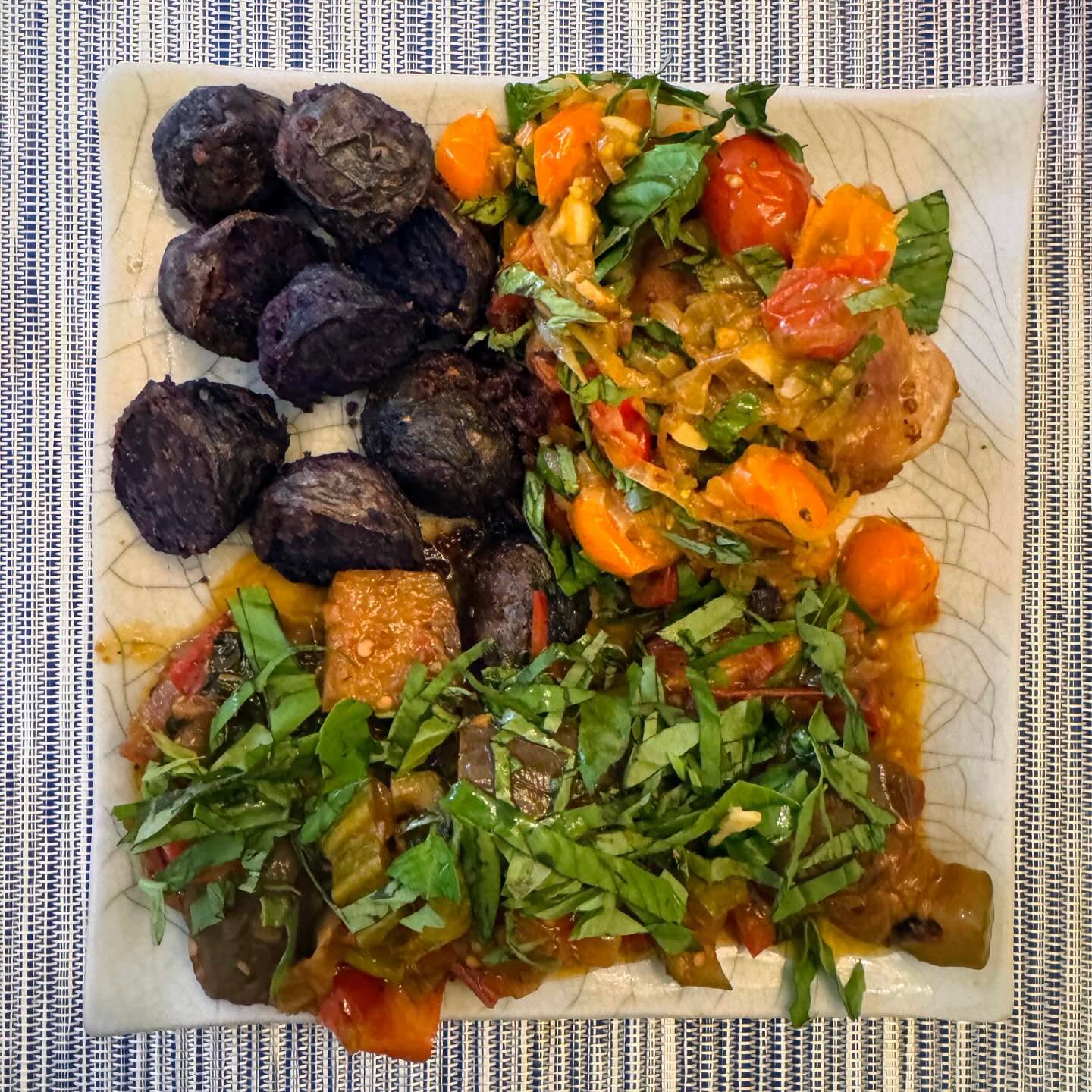
Roast Chicken Thighs with Schmaltzy Tomatoes and Spring Onion
Giving the chicken a head start renders its fat before the tomatoes release their juice. The tomatoes and onions then soften in the schmaltz without preventing the skin from browning.
Ingredients
- 8 bone-in, skin-on chicken thighs, about 3 lb total
- 1 1/2 tsp fine sea salt, plus more to taste
- 1/2 tsp freshly ground black pepper
- 1 1/2 lb mixed red and gold cherry tomatoes, large ones halved
- 6 spring onions or large scallions, whites and pale greens cut into 2-inch lengths, dark greens thinly sliced
- 4 cloves garlic, thinly sliced
- 4 sprigs thyme
- 2 tsp red wine vinegar, plus more to taste
- 1/4 cup loosely packed fresh basil leaves, sliced just before serving
Instructions
- Heat the oven to 425°F with racks in the upper and lower thirds. Pat the chicken thoroughly dry and season all over with the salt and pepper. If time permits, refrigerate uncovered for 4–24 hours before cooking.
- Arrange the thighs skin-side up in a large, shallow roasting pan with a little space between them. Roast on the upper rack for 20 minutes, until fat has accumulated in the pan and the skin is beginning to color.
- Toss the tomatoes, spring onion whites and pale greens, garlic, and thyme with the rendered fat around the chicken. Keep the vegetables beside the thighs rather than on top of the skin.
- Roast another 25–35 minutes, stirring the vegetables once, until the tomatoes have slumped and the chicken skin is golden. Check several thighs away from the bone: 175–185°F gives tender dark meat, with 165°F the minimum safe temperature.
- Transfer the chicken to a warm platter and rest for 10 minutes. Discard the thyme stems. Stir the vinegar and sliced onion greens into the tomatoes and pan juices, then taste for salt and acidity.
- If the juices are thin, transfer the tomato mixture to a saucepan and simmer for 3–5 minutes until glossy and lightly spoonable. Serve with the chicken and finish with basil.
Notes
- Use a metal roasting pan or rimmed sheet pan rather than a deep casserole; crowding and trapped steam inhibit browning.
- If the skin needs more color, briefly broil the chicken before removing it from the pan, watching closely.
Duck Fat Roasted Purple Potatoes
A short parboil softens the centers and roughens the surfaces so duck fat can form a crisp crust. Thick rounds preserve the striking purple interiors.
Ingredients
- 2 lb medium purple potatoes, scrubbed and cut into 3/4-inch-thick rounds
- 3 tbsp duck fat, melted
- 1 tsp fine sea salt, plus more for the boiling water
- 1/4 tsp freshly ground black pepper
Instructions
- Put the potato rounds in a saucepan, cover with cold water by 1 inch, and salt the water generously. Bring to a boil, then simmer gently for 6–8 minutes, until the edges yield to a knife but the centers remain firm.
- Drain well and let steam-dry for 5 minutes. Gently shake the colander to roughen the edges without breaking the rounds.
- Toss with the melted duck fat, salt, and pepper. Arrange in a single layer on a heavy rimmed sheet pan, leaving space between pieces.
- Roast at 425°F for 40–50 minutes, turning after about 25 minutes, until crisp outside and creamy all the way through. Rotate the pan if browning is uneven.
- Taste and add a final pinch of salt while hot.
Notes
- Purple potatoes brown less visibly than yellow potatoes; judge by crisp edges and a completely tender center.
Summer Ratatouille with Basil
Roasting the eggplant and zucchini separately concentrates their flavor and keeps the finished stew chunky rather than watery. Peppers, tomatoes, and onions provide a soft, sweet base, sharpened with a little vinegar.
Ingredients
- 1 lb eggplant, cut into 1-inch pieces
- 3/4 lb zucchini, cut into 3/4-inch pieces
- 5 tbsp extra-virgin olive oil, divided
- 1 1/4 tsp fine sea salt, divided, plus more to taste
- 1 large yellow onion, cut into 3/4-inch pieces
- 2 bell peppers, one red and one yellow, cut into 1-inch pieces
- 4 cloves garlic, thinly sliced
- 1 lb ripe tomatoes, roughly chopped
- 3 sprigs thyme
- 2 tsp red wine vinegar, plus more to taste
- 1/2 cup loosely packed basil leaves, cut into broad ribbons
- 1/4 tsp freshly ground black pepper
Instructions
- Heat the oven to 425°F. Toss the eggplant and zucchini with 3 tablespoons olive oil and 3/4 teaspoon salt. Spread on a large sheet pan in a single layer.
- Roast for 25–30 minutes, turning once, until the eggplant is tender and the zucchini has lightly browned edges.
- Meanwhile, warm the remaining 2 tablespoons olive oil in a wide, heavy pot over medium-low heat. Add the onion, peppers, and remaining 1/2 teaspoon salt. Cover and sweat for 12–15 minutes, stirring occasionally, until softened without deep browning.
- Add the garlic and cook for 1 minute. Add the tomatoes and thyme, then simmer uncovered for 12–15 minutes, until the tomatoes break down and their juices begin to thicken.
- Fold in the roasted eggplant and zucchini. Simmer gently for 5–10 minutes so the flavors mingle while the vegetables retain their shape.
- Remove the thyme stems. Stir in the vinegar, black pepper, and half the basil. Adjust the salt and acidity, then finish with the remaining basil just before serving.
Notes
- Ratatouille can be made a day ahead; reheat gently and add the basil at serving time.
- If the vegetables release excess water, simmer uncovered in a wide pan rather than stirring aggressively.
Overall Timing / Workflow
Making the ratatouille first avoids crowding the oven and lets its flavors settle while the chicken and potatoes roast together.
Instructions
- 0:00 — Heat the oven to 425°F. Season the chicken and refrigerate while preparing the vegetables. Start the ratatouille's roasted vegetables and stovetop tomato-pepper base.
- 0:30 — Fold the roasted vegetables into the ratatouille and finish simmering. Set aside covered, reserving the finishing basil.
- 0:35 — Put the chicken on the upper oven rack. Parboil, drain, and steam-dry the potatoes.
- 0:50 — Put the duck fat potatoes on the lower rack.
- 0:55 — Add the tomatoes, spring onions, garlic, and thyme around the chicken. Turn the potatoes about 25 minutes into their roasting time.
- 1:20–1:30 — Check the chicken for doneness and remove when ready. Rest it while finishing the tomato juices and checking the potatoes for crispness.
- 1:30–1:40 — Gently warm the ratatouille if needed. Finish both vegetable mixtures with basil and serve when the potatoes are crisp.
Notes
- The chicken may finish before the potatoes; its resting window accommodates this. If the oven is crowded, allow extra roasting time and rotate the pans.
Plating
Keeping the potatoes away from the pan juices preserves their crisp edges, while generous basil ties the two tomato-rich components together.
Instructions
- Arrange two chicken thighs per plate and spoon the schmaltzy tomatoes and spring onions around and partly over them, leaving some browned skin exposed.
- Place the purple potato rounds in a separate cluster, away from pooled juices.
- Spoon the ratatouille alongside and scatter the reserved basil over the vegetables. Serve immediately.
Leftover Path
Separate storage keeps the potatoes from absorbing sauce, and the ratatouille becomes even more flavorful overnight.
Instructions
- Refrigerate within 2 hours, storing the chicken and tomato juices together, the potatoes separately, and the ratatouille in its own container. Use within 3–4 days.
- Reheat chicken and tomatoes in a covered baking dish at 350°F until the chicken reaches 165°F; uncover near the end to help dry the skin.
- Re-crisp potatoes on a hot sheet pan at 425°F for 12–18 minutes. Warm the ratatouille gently on the stovetop, adding a splash of water only if needed.
- For a different next-day meal, pull the chicken from the bones and warm it in the ratatouille with a spoonful of the tomato juices.