Shallow-Poached Halibut with Peas and Shallots, Roasted Spring Vegetables
Gently poached halibut sits in a light, buttery broth with sweet peas, soft shallots and a bright finish of lemon and parsley. Deeply roasted fennel, rainbow carrots, cauliflower and meaty mushrooms bring caramelized edges and earthy contrast to a spring fish supper.
By Jonathan Katzman · Cooked and photographed · Recipe updated
Serves: 4 servings
Tags: gluten-free, nut-free, pescatarian
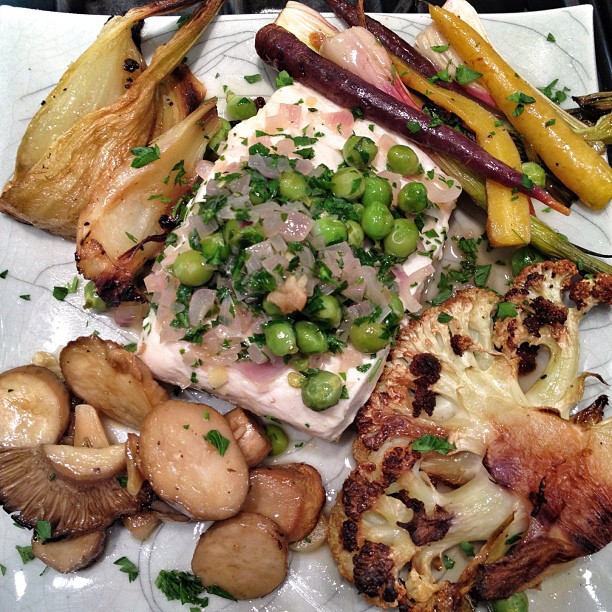
Shallow-Poached Halibut with Peas and Shallots
A shallow, barely simmering bath cooks the halibut gently while creating a delicate sauce. Peas go in near the end so they stay sweet and green.
Ingredients
- 4 portions skinless halibut, 6 ounces each and about 1–1½ inches thick
- 3 medium shallots, finely diced
- 4 tablespoons unsalted butter, divided
- ½ cup dry white wine
- 1 cup light gluten-free fish or vegetable stock, plus more as needed
- 1½ cups shelled peas, fresh or frozen
- 1 tablespoon fresh lemon juice, plus more to taste
- 2 tablespoons finely chopped flat-leaf parsley
- to taste kosher salt and freshly ground black pepper
Instructions
- Season the halibut lightly with salt and refrigerate while preparing the vegetables.
- Melt 1 tablespoon butter in a wide, lidded sauté pan over medium-low heat. Add the shallots and a pinch of salt; sweat for 4–5 minutes until translucent without browning.
- Add the wine and simmer for 2–3 minutes to reduce by about half. Add the stock and bring to a very gentle simmer.
- Nestle the halibut into the pan, adding a little stock if needed so the liquid reaches roughly one-third to halfway up the fish. Cover and cook over low heat, keeping the liquid below a boil, for 7–12 minutes depending on thickness.
- Add fresh peas around the fish for the final 3–5 minutes, or frozen peas for the final 2–3 minutes. The halibut should separate into moist flakes and reach 145°F at its thickest point; remove individual portions as they finish.
- Transfer the fish to warm plates. If the cooking liquid is thin, simmer it briefly with the peas and shallots until lightly concentrated. Lower the heat and swirl in the remaining 3 tablespoons cold butter, a little at a time.
- Stir in the lemon juice and parsley. Taste for salt and pepper, then spoon the peas, shallots and glossy broth over the fish.
Notes
- Use a pan that holds the fish snugly in one layer so it does not require excessive poaching liquid.
- Keep the sauce loose and spoonable rather than reducing it to a thick glaze.
Roasted Fennel Wedges
Keeping a little core attached holds the wedges together while their cut faces brown and their centers turn silky.
Ingredients
- 2 medium fennel bulbs
- 1½ tablespoons extra-virgin olive oil
- 1 teaspoon fresh lemon juice
- to taste kosher salt and freshly ground black pepper
Instructions
- Heat the oven to 425°F. Trim the fennel stalks and any tough outer layers. Cut each bulb into 6 wedges, leaving a small piece of core attached to each.
- Toss with olive oil, salt and pepper. Arrange on a rimmed baking sheet with a cut side down.
- Roast for 30–40 minutes, turning once, until the edges are deeply golden and a knife slides easily into the thickest part.
- Finish with lemon juice just before serving.
Roasted Rainbow Carrots
Lengthwise cuts give the carrots plenty of browning surface while preserving their shape and natural sweetness.
Ingredients
- 1 lb slender rainbow carrots, scrubbed and trimmed
- 1 tablespoon extra-virgin olive oil
- to taste kosher salt and freshly ground black pepper
Instructions
- Halve the carrots lengthwise, quartering any especially thick ones so they cook evenly.
- Toss with olive oil, salt and pepper and arrange in a single layer on a baking sheet.
- Roast at 425°F for 25–35 minutes, turning once, until lightly blistered and tender with a little resistance at the center.
Notes
- Keep purple carrots together on one section of the tray to limit staining of the lighter vegetables.
Deeply Roasted Cauliflower
Broad, flat cuts maximize contact with the hot tray, producing dark caramelized patches while the stems become tender.
Ingredients
- 1 large head cauliflower
- 2 tablespoons extra-virgin olive oil
- to taste kosher salt and freshly ground black pepper
Instructions
- Trim the cauliflower leaves and the tough end of the stem, retaining the core. Cut through the center into ¾-inch slabs; cut the loose outer pieces into large, flat-sided florets.
- Coat with olive oil, salt and pepper. Arrange in one layer on a metal baking sheet, placing broad cut faces against the tray.
- Roast at 425°F for 25–35 minutes, turning carefully after about 20 minutes, until deeply browned in patches and tender through the stems.
Notes
- Do not crowd the tray: trapped moisture prevents the pronounced browning that gives this side its character.
Roasted King Trumpet Mushrooms
Thick slices retain a meaty center while roasting concentrates their flavor and browns their edges.
Ingredients
- 12 ounces king trumpet mushrooms, tough stem ends trimmed
- 1½ tablespoons extra-virgin olive oil
- 1 tablespoon chopped flat-leaf parsley
- to taste kosher salt and freshly ground black pepper
Instructions
- Cut the thick mushroom stems crosswise into ½-inch rounds. Halve or quarter the caps into similarly sized pieces.
- Toss with olive oil, salt and pepper. Spread on a baking sheet with space between the pieces.
- Roast at 425°F for 20–25 minutes, turning halfway through, until browned and tender rather than wet and spongy.
- Toss with parsley just before serving.
Overall Timing / Workflow
The vegetables roast first and tolerate a short hold, leaving the final minutes free for the delicate fish and its sauce.
Instructions
- 0:00 — Heat the oven to 425°F with racks in the upper and lower thirds. Prepare the fennel and start roasting it.
- 0:10 — Add the carrots and cauliflower on separate sections of a second tray. Leave space between pieces; use a third tray or roast in batches if needed.
- 0:20 — Turn the fennel as needed and add the mushrooms to an uncrowded tray. Rotate trays between racks for even browning.
- 0:25 — Season the fish, dice the shallots, measure the poaching ingredients and chop the parsley.
- 0:35 — Begin the shallot and wine base. Remove vegetables as they become tender and browned; hold loosely covered in a warm spot.
- 0:42 — Add the halibut to the poaching liquid, then add the peas near the end of cooking. Briefly return the vegetables to the oven if they need warming.
- 0:50–0:55 — Finish the sauce with butter, lemon and parsley, and plate immediately.
Notes
- Use vegetable doneness rather than the clock as the final guide; oven crowding and carrot thickness affect timing.
Plating
A central fish portion with distinct vegetable clusters preserves the contrast between delicate poaching and deeply browned roasting.
Instructions
- Set one halibut portion in the center of each warm, wide plate.
- Spoon peas and shallots over the fish, allowing a little sauce to pool around its base.
- Arrange fennel, carrots, cauliflower and mushrooms in separate clusters around the fish, keeping the darkest browned surfaces facing up.
- Distribute any remaining parsley from the prepared components over the vegetables and serve immediately.
Leftover Path
Storing the fish separately protects its delicate texture and lets the vegetables be reheated more assertively.
Instructions
- Refrigerate leftovers within 2 hours in shallow, covered containers. Store the fish with its pea-shallot sauce separately from the roasted vegetables.
- Use the fish within 2 days. Reheat covered with a splash of water over low heat until it reaches 165°F, avoiding a hard boil.
- Reheat the vegetables on a baking sheet at 400°F for 10–15 minutes, until hot and their edges regain some texture. Use within 3–4 days.
- Alternatively, flake the chilled fish into a lemon-dressed salad and serve the roasted vegetables alongside.