Sous Vide Swordfish with Ginger-Scallion Sauce, Miso-Tahini Cabbage and Roasted Hokkaido Squash
Tender swordfish gets a generous spoonful of warm ginger-scallion sauce, with ssamjang and bok choy kimchi alongside for heat and fermented depth. Charred arrowhead cabbage under silky wild leek miso–tahini sauce and caramelized Hokkaido squash make this a satisfying late-fall plate.
By Jonathan Katzman · Cooked and photographed · Recipe updated
Serves: 4 servings
Tags: gluten-free, dairy-free, nut-free, pescatarian
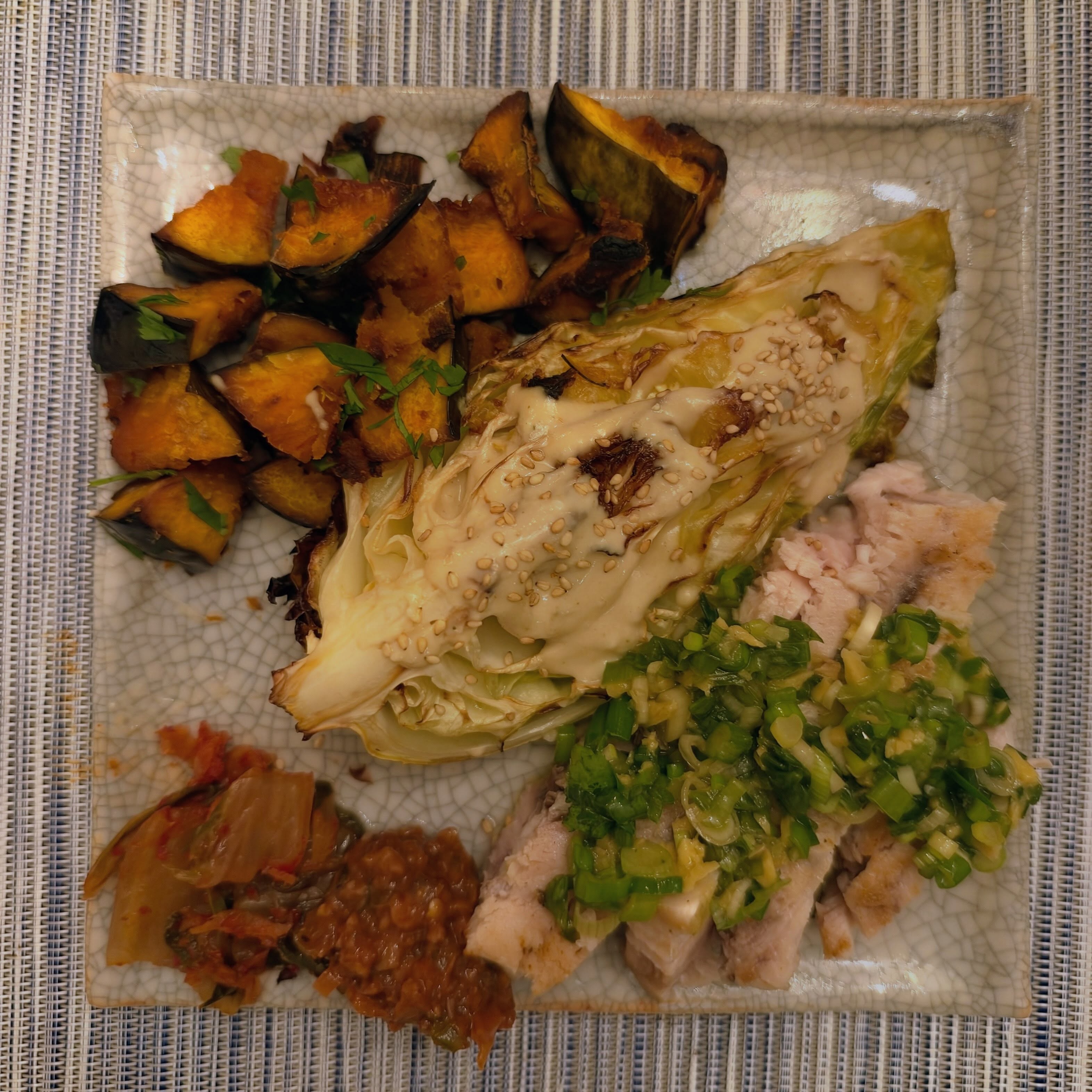
Sous Vide Swordfish
Controlled cooking keeps thick swordfish steaks evenly cooked. A very brief sear adds a little color without building a heavy crust beneath the scallion sauce.
Ingredients
- 4 skinless swordfish steaks, 6 ounces each and about 1 inch thick
- 3/4 teaspoon fine sea salt
- 1/4 teaspoon freshly ground black pepper
- 1 tablespoon avocado oil
Instructions
- Heat a sous vide bath to 145°F / 63°C.
- Season the swordfish with salt and pepper. Seal in cooking-safe bags in a single layer, using gentle vacuum pressure or water displacement.
- Submerge and cook for 60–70 minutes for refrigerated steaks about 1 inch thick. Keep the bags fully submerged and separated so water circulates around them.
- Remove the fish from the bags and pat very dry. Heat the avocado oil in a large skillet over high heat until shimmering.
- Sear for 30–45 seconds per broad side, just until lightly golden. Check that the center reaches 145°F / 63°C; if necessary, finish over gentler heat until it does.
- Slice across the grain into thick pieces and serve immediately.
Notes
- Timing assumes fully thawed, 1-inch-thick steaks; thicker pieces require longer in the bath.
- Swordfish is high in mercury and should be avoided by pregnant or breastfeeding people and young children.
Ginger-Scallion Sauce
Hot oil softens the raw bite of ginger and scallions while preserving their fragrance. A little vinegar cuts through the rich fish and oil.
Ingredients
- 2 bunches scallions, trimmed and thinly sliced, about 2 cups
- 3 tablespoons finely minced fresh ginger
- 1/3 cup avocado oil
- 1 teaspoon toasted sesame oil
- 2 teaspoons unseasoned rice vinegar
- 1 teaspoon gluten-free tamari
- 1/4 teaspoon fine sea salt, plus more to taste
Instructions
- Put the scallions, ginger and salt in a large heatproof metal bowl.
- Heat the avocado oil in a small saucepan until shimmering, about 250°F / 120°C; do not let it smoke.
- Carefully pour the oil over the aromatics, keeping your face and hands back from any sputtering. Stir and let stand for 5 minutes.
- Stir in the sesame oil, vinegar and tamari. Taste for salt. The sauce should be chunky and spoonable, with enough oil to coat the scallions rather than submerge them.
Notes
- Serve warm or at room temperature. If made ahead, refrigerate promptly and gently warm only the amount needed.
Roasted Arrowhead Cabbage
Wedges held together by the core develop browned cut surfaces while their inner leaves turn tender and sweet. Keeping the sauce off until serving preserves the crisp edges.
Ingredients
- 2 small heads arrowhead cabbage, about 2 pounds total
- 2 tablespoons avocado oil
- 1/2 teaspoon fine sea salt
- 2 teaspoons toasted sesame seeds
Instructions
- Heat the oven to 425°F / 220°C. Cut each cabbage lengthwise in half, retaining enough core to hold the leaves together. If the heads are large, cut into quarters instead.
- Rub the wedges with avocado oil, working a little between the outer leaves, and season with salt.
- Place cut-side down on a heavy sheet pan. Roast for 20–25 minutes, until the underside is deeply browned.
- Turn and roast for another 10–15 minutes, until a knife slides easily through the thickest part and the outer leaves have crisp, dark edges.
- Transfer to plates and finish with the miso-tahini sauce and sesame seeds.
Notes
- Avoid crowding the pan; trapped steam prevents the cut faces from browning.
Wild Leek Miso–Tahini Sauce
Tahini gives the sauce body without dairy, while wild leek miso adds savory allium depth. Rice vinegar keeps it lively against sweet roasted cabbage.
Ingredients
- 1/4 cup well-stirred tahini
- 1 1/2 tablespoons Shared Cultures wild leek miso, verified gluten-free
- 1 tablespoon unseasoned rice vinegar
- 1 teaspoon honey
- 4–6 tablespoons warm water
Instructions
- Whisk the tahini, miso, vinegar and honey together. The mixture may tighten initially.
- Whisk in warm water a tablespoon at a time until smooth and thickly pourable. It should coat a cabbage leaf without sitting on it like a paste.
- Taste and adjust with a little more vinegar if needed. Keep at room temperature until serving.
Notes
- Miso salinity varies; start with 1 tablespoon if yours is particularly salty, then add more to taste.
- If wild leek miso is unavailable, use a verified gluten-free mild miso with 1 tablespoon very finely minced chives.
Roasted Hokkaido Squash
High heat concentrates the squash's chestnut-like sweetness and browns its cut edges. The edible skin helps the pieces keep their shape.
Ingredients
- 1 medium Hokkaido squash, about 2 pounds
- 2 tablespoons avocado oil
- 1/2 teaspoon fine sea salt
- 1/4 teaspoon freshly ground black pepper
- 1 tablespoon roughly chopped cilantro, optional
Instructions
- Heat the oven to 425°F / 220°C. Scrub the squash, halve it and remove the seeds. Leave the skin on and cut into roughly 1 1/2-inch chunks.
- Toss with avocado oil, salt and pepper. Spread on a separate sheet pan with a flat cut surface against the pan.
- Roast for 35–45 minutes, turning after about 25 minutes, until deeply browned at the edges and completely tender inside.
- Scatter with the optional cilantro just before serving.
Notes
- The squash needs no added sweetener; let its browned edges provide the sweetness.
Ssamjang
A small portion of thick, fermented chile-bean paste gives each bite a savory counterpoint without competing with the ginger-scallion sauce.
Ingredients
- 3 tablespoons gluten-free doenjang
- 1 tablespoon gluten-free gochujang
- 1 tablespoon finely minced scallion
- 1 small clove garlic, finely grated
- 2 teaspoons toasted sesame oil
- 1 teaspoon honey
- 1 teaspoon toasted sesame seeds
- 1–2 teaspoons water, as needed
Instructions
- Stir together the doenjang, gochujang, scallion, garlic, sesame oil, honey and sesame seeds.
- Add just enough water to make a soft dipping paste, not a pourable sauce.
- Let stand for 10 minutes before serving. Offer a small spoonful per person, with the remainder on the table.
Notes
- A prepared gluten-free ssamjang can replace this component.
Bok Choy Kimchi
Cool, crunchy kimchi supplies acidity and chile heat against the warm fish and sweet roasted vegetables.
Ingredients
- 1 cup Volcano Kimchi bok choy kimchi, verified gluten-free
Instructions
- Lift the kimchi from its brine without squeezing it dry.
- Cut any very long pieces into manageable lengths and divide into four small portions.
- Serve cool alongside, rather than underneath, the hot components.
Overall Timing / Workflow
The fish cooks while the vegetables roast, leaving only a quick sear and final assembly at the end.
Instructions
- 0:00 — Heat the sous vide bath to 145°F / 63°C and the oven to 425°F / 220°C. Season and bag the fish.
- 0:10 — Put the fish in the bath once it reaches temperature. Cut and season the squash and cabbage.
- 0:25 — Put the squash and cabbage into the oven on separate sheet pans, leaving room for air circulation.
- 0:30 — Make the miso-tahini sauce and ssamjang, then prepare the ginger-scallion sauce.
- 0:50 — Turn the vegetables and rotate the pans between racks if they are browning unevenly. Portion the kimchi.
- 1:00–1:10 — Remove each vegetable when tender and browned. If the fish needs more time, keep the vegetables loosely covered, then briefly re-crisp in the oven before plating.
- 1:10–1:25 — Once the fish has completed its bath time, dry it, sear briefly and check its center temperature. Slice, sauce and serve.
Plating
Keeping the sauces in distinct areas lets the fish, cabbage and fermented sides retain their individual flavors and textures.
Instructions
- Place a roasted cabbage wedge diagonally across each warm plate. Spoon miso-tahini sauce along its cut face and scatter with sesame seeds.
- Arrange the roasted squash beside the cabbage.
- Fan the sliced swordfish into the remaining space and generously spoon ginger-scallion sauce over it.
- Add a small mound of bok choy kimchi and a spoonful of ssamjang at the edge, keeping them separate from the tahini sauce.
Leftover Path
Separate storage protects the roasted vegetables from soggy sauces and keeps the fish from absorbing too much salt.
Instructions
- Refrigerate fish, vegetables and sauces separately in shallow covered containers within 2 hours. Keep the kimchi refrigerated in its own container.
- Use the cooked fish within 3 days and the roasted vegetables, ginger-scallion sauce, miso-tahini sauce and homemade ssamjang within 3–4 days.
- Re-crisp the cabbage and squash in a 400°F / 205°C oven for 10–15 minutes. Thin the miso-tahini sauce with a little water if it has thickened.
- For a next-day meal, flake the fish cold over reheated squash and cabbage, then add ginger-scallion sauce and kimchi. If reheating the fish, cover it with a splash of water and heat gently to 165°F / 74°C, understanding that it will become firmer.