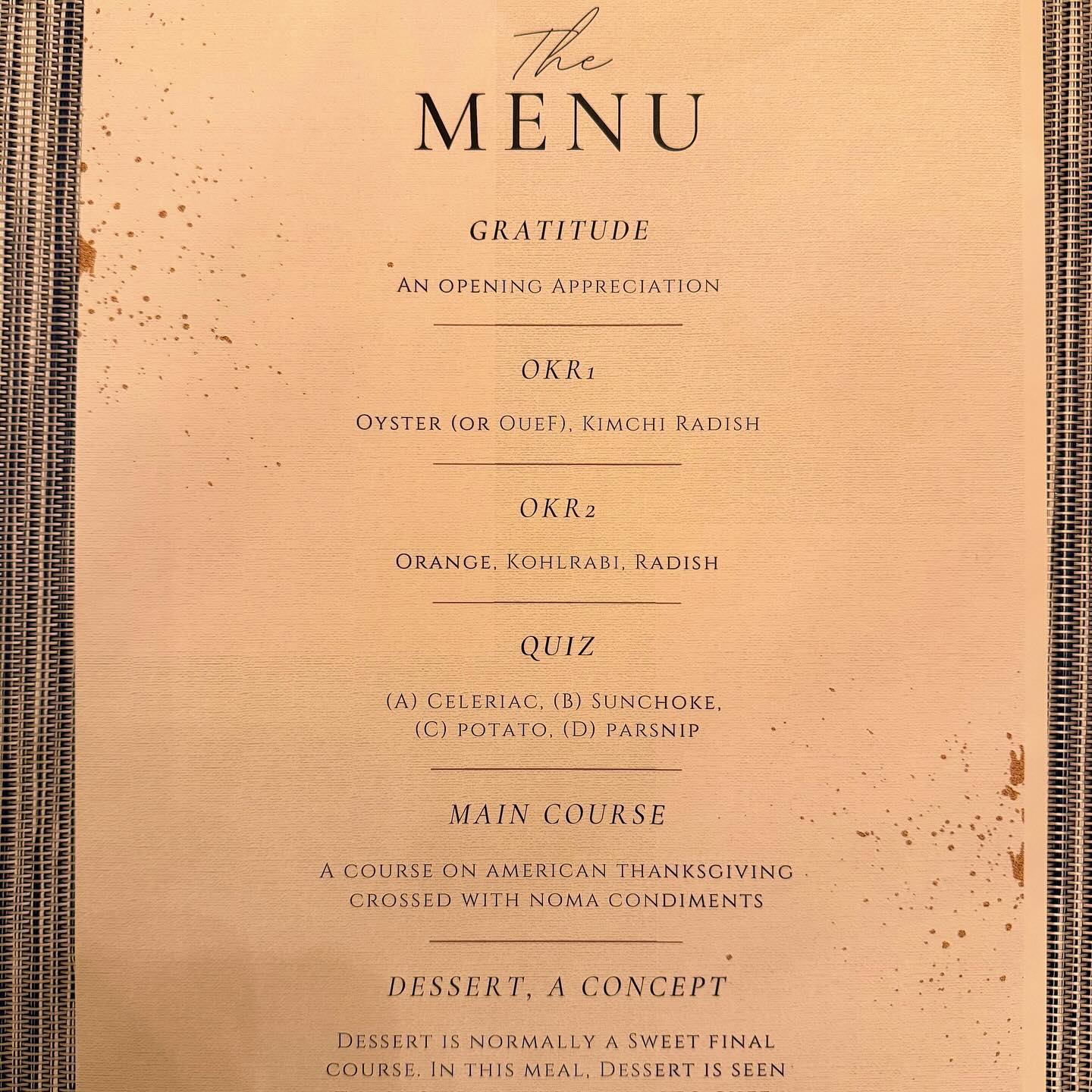
ChezJK Team Dinner: Oysters, Winter Citrus, Sunchoke Soup, Koji Turkey and Fall Fruit
A late-fall dinner that moves from briny oysters and sharp winter citrus to silky sunchoke soup and tender koji-marinated turkey. Fermented mushroom condiments sharpen the roasted vegetables, while pears, persimmons and nut-butter sauces make a fresh, textured dessert before a final peppermint macaron.
By Jonathan Katzman · Cooked and photographed · Recipe updated
Serves: 4 servings
Tags: gluten-free
Oysters with Kimchi Radish
A small amount of crisp, acidic radish seasons the oyster without burying its briny flavor.
Ingredients
- 4 fresh live oysters, refrigerated
- 2 tablespoons gluten-free radish kimchi, sliced into thin small pieces
- 1 teaspoon brine from the radish kimchi
- crushed ice, for serving
Instructions
- Scrub the oysters under cold running water. Discard cracked oysters and any open oyster that does not close when tapped.
- Shuck just before serving, keeping the cupped shells level to retain their liquor. Remove shell fragments and release each oyster from its shell.
- Set on crushed ice and top each oyster with a few thin pieces of radish kimchi and just a drop or two of brine. Serve immediately.
Notes
- Choose mild, crisp radish kimchi rather than a heavily dressed spoonful of cabbage kimchi.
- Raw oysters are unsuitable for people at increased risk from foodborne illness; serve them fully cooked instead.
Orange, Purple Daikon and Radish-Green Salad
Sweet orange softens the daikon's peppery bite, while tender radish shoots keep the salad light and crisp.
Ingredients
- 300 g purple daikon, scrubbed and coarsely grated or finely julienned
- 2 navel oranges
- 1 cup tender radish greens or purple radish microgreens
- 1 tablespoon unseasoned rice vinegar
- 1 1/2 tablespoons extra-virgin olive oil
- 1/4 teaspoon fine sea salt, plus more to taste
Instructions
- Toss the daikon with the salt and let stand for 5 minutes. Gently squeeze away excess liquid without crushing the shreds.
- Cut the peel and white pith from the oranges over a bowl, reserving the juice. Slice the flesh into thin half-rounds.
- Whisk 1 tablespoon reserved orange juice with the rice vinegar and olive oil. Toss with the daikon and taste for salt.
- Fold in the radish greens immediately before serving, then arrange the orange slices over the salad.
Notes
- Use only young, tender radish leaves raw; mature leaves can be coarse and prickly.
Sunchoke Soup with Pepitas and Olive Oil
Gentle sweating preserves the sunchokes' sweet, nutty character. Cream and thorough blending give the soup body without adding potato.
Ingredients
- 500 g sunchokes, scrubbed, trimmed and thinly sliced
- 1 small leek, white and pale-green parts washed and sliced
- 1 tablespoon unsalted butter
- 2 1/2 cups gluten-free vegetable stock, plus more as needed
- 1/3 cup heavy cream
- 1–2 teaspoons lemon juice
- 2 tablespoons pepitas
- 2 teaspoons extra-virgin olive oil, for finishing
- to taste fine sea salt and white pepper
Instructions
- Melt the butter in a saucepan over medium-low heat. Add the leek and a pinch of salt; sweat for 7–8 minutes without browning.
- Add the sunchokes and stock. Bring to a simmer, cover loosely and cook for 20–25 minutes, until the sunchokes collapse easily under a spoon.
- Toast the pepitas in a dry skillet over medium-low heat for 3–5 minutes, stirring until fragrant and beginning to pop.
- Blend the soup with the cream until very smooth, venting the blender safely if the soup is hot. Pass through a fine sieve for a more refined finish.
- Return to low heat and add stock as needed for a thick but pourable soup. Season with lemon juice, salt and white pepper.
- Serve in small warm bowls with a narrow line of pepitas and a drizzle of olive oil.
Notes
- Peel especially rough or dark-skinned sunchokes for a paler soup.
- Sunchokes can cause digestive discomfort; the modest tasting-course portion is intentional.
Shio Koji Turkey Breast
Shio koji seasons the breast throughout and helps retain moisture. A controlled water bath gives an even interior, followed by a brief sear for a savory crust.
Ingredients
- 800 g boneless skin-on turkey breast, no more than 2 1/2 inches thick
- 65 g gluten-free shio koji
- 1/2 teaspoon freshly ground black pepper
- 1 tablespoon ghee
Instructions
- Coat the turkey with shio koji, place in a covered container and refrigerate for 12–18 hours. Do not add salt.
- Heat a sous vide bath to 145°F / 63°C. Wipe away excess koji, season with pepper and seal the turkey in a food-safe bag in a single layer.
- Cook for approximately 3 1/2–4 hours for a breast up to 2 1/2 inches thick. Verify that the center reaches 145°F and remains there for at least 30 minutes; thickness and starting temperature affect the required time.
- Remove the turkey from the bag and dry it thoroughly. Let the surface steam-dry for 5 minutes.
- Heat the ghee in a skillet over medium-high heat. Sear skin-side down for 1–2 minutes, pressing lightly for contact, then briefly sear the other surfaces. Reduce the heat if the residual koji begins to scorch.
- Rest for 5 minutes and slice across the grain into 1/2-inch slices.
Notes
- For a conventional oven method, wipe and dry the marinated breast, sear in ghee, then roast at 325°F / 165°C until the center reaches 165°F / 74°C. Rest for 10 minutes before slicing.
- Do not use the water-bath timing for a thicker rolled breast or a bone-in breast.
Dark Mushroom and Citrus-Chile Turkey Condiments
Separate small dots give each bite a choice between deep fermented savoriness and bright citrus heat.
Ingredients
- 2 teaspoons gluten-free dark fermented mushroom condiment or mushroom XO
- 1 teaspoon gluten-free yellow yuzu kosho
- 1 teaspoon lemon juice
- 1 teaspoon extra-virgin olive oil
Instructions
- Place the mushroom condiment in a small serving bowl.
- Stir the yuzu kosho with the lemon juice and olive oil to make a spoonable citrus-chile condiment.
- Taste both with a piece of turkey. Serve in very small dots, starting with about 1/2 teaspoon mushroom condiment and 1/4 teaspoon citrus condiment per plate.
Notes
- If using Noma condiments from your pantry, choose one dark savory condiment and one citrus-forward condiment, and adjust the portions to their salt level.
Roasted Brussels Sprouts
A hot, uncrowded sheet pan browns the cut surfaces while keeping the centers tender rather than waterlogged.
Ingredients
- 500 g Brussels sprouts, trimmed and halved
- 1 1/2 tablespoons olive oil
- 1/4 teaspoon fine sea salt
- to taste black pepper
Instructions
- Heat the oven to 425°F / 220°C with a heavy sheet pan inside.
- Dry the sprouts thoroughly and toss with olive oil, salt and pepper.
- Carefully arrange cut-side down on the hot pan. Roast for 20 minutes, then turn and cook for 5–10 minutes more, until deeply browned with tender centers and crisp outer leaves.
- Toss with the forager's vinaigrette immediately before serving, starting with half the prepared dressing and adding more to taste.
Forager's Vinaigrette
A tart, herbaceous dressing lifts the browned sprouts without masking their roasted sweetness.
Ingredients
- 1 tablespoon gluten-free prepared forager's vinaigrette
- 1 tablespoon extra-virgin olive oil
- 1 teaspoon apple cider vinegar, as needed
Instructions
- Stir the prepared forager's vinaigrette with the olive oil.
- Taste against a hot Brussels sprout. Add the cider vinegar only if the dressing needs more acidity.
- Spoon lightly over the hot sprouts and toss just before serving.
Notes
- Without the named condiment, combine 1 tablespoon cider vinegar, 2 tablespoons olive oil, 1 teaspoon finely chopped capers, 1 tablespoon chopped parsley and a pinch of salt. This is a practical herbal dressing, not a replica of the proprietary product.
Roasted Delicata Squash
Thin half-moons develop caramelized edges while keeping the edible skin intact. The mushroom dressing supplies savory contrast to the squash.
Ingredients
- 2 small delicata squash, about 700 g total
- 1 1/2 tablespoons olive oil
- 1/4 teaspoon fine sea salt
- to taste black pepper
Instructions
- Heat the oven to 425°F / 220°C. Scrub the squash, halve lengthwise, remove the seeds and cut into 3/8-inch half-moons.
- Toss with olive oil, salt and pepper. Spread on a sheet pan in one layer.
- Roast for 25–30 minutes, turning after about 15 minutes, until tender with browned edges.
- Gently toss the warm squash with the mushroom garum vinaigrette, adding it gradually so the squash is glossy rather than swimming in dressing.
Mushroom Garum Vinaigrette
Fermented mushroom flavor adds depth, while cider vinegar prevents the sweet squash from tasting heavy.
Ingredients
- 2 teaspoons gluten-free mushroom garum
- 1 tablespoon apple cider vinegar
- 1 1/2 tablespoons extra-virgin olive oil
- 1 teaspoon water, plus more as needed
Instructions
- Whisk the mushroom garum with the cider vinegar and water.
- Whisk in the olive oil and taste with a piece of squash.
- Add a little water if overly salty, or a few drops more vinegar if the dressing tastes flat. Whisk again before using.
Notes
- Garum varies considerably in strength; start with half the amount if yours is especially concentrated.
Fall Fruit with Dates, Pomegranate and Toasted Crunch
Juicy pear, crisp persimmon and chewy dates provide distinct textures. Pomegranate and toasted toppings balance the richness of the nut sauces.
Ingredients
- 2 ripe but firm pears
- 2 firm-ripe Fuyu persimmons
- 4 Medjool dates, pitted and quartered
- 1/3 cup pomegranate arils
- 2 tablespoons unsweetened coconut flakes
- 2 tablespoons pepitas
- 2 teaspoons lemon juice
Instructions
- Toast the coconut and pepitas separately in a 325°F / 165°C oven, checking after 4 minutes and removing each when lightly golden and fragrant. Cool.
- Core the pears and cut into irregular wedges. Toss lightly with lemon juice.
- Remove the persimmon stems and cut the fruit into thick wedges or half-rounds.
- Arrange the pears, persimmons and dates with space between them. Add the nut-butter sauces, then scatter with pomegranate, coconut and pepitas.
Notes
- Use Fuyu persimmons for this crisp preparation; unripe Hachiya persimmons are astringent.
Almond and Pistachio Dessert Sauces
Thinning nut butter creates two distinct, lightly sweet sauces that cling to fruit instead of turning the dessert into a heavy cream course.
Ingredients
- 3 tablespoons smooth unsweetened almond butter
- 3 tablespoons smooth unsweetened pistachio butter
- 2 teaspoons maple syrup, divided
- 2 teaspoons lemon juice, divided
- 4–6 tablespoons warm water, divided, as needed
- 2 pinches fine sea salt
Instructions
- Place each nut butter in a separate bowl. Add 1 teaspoon maple syrup, 1 teaspoon lemon juice and a pinch of salt to each.
- Whisk warm water into each sauce a teaspoon at a time. The mixtures may initially tighten; continue whisking and adding water until glossy and spoonable.
- Keep the almond sauce slightly thick for ribbons over the dates, and thin the pistachio sauce a little further for small pools beside the pears.
- Taste with the fruit and adjust with a few drops of lemon juice or maple syrup.
Notes
- Stir separated nut butters thoroughly before measuring. Rewhisk with a little water if the sauces thicken while standing.
Honey-Meringue Peppermint Macaron Shells
Almond flour and cooked-honey meringue make a delicate almond sandwich cookie with a chewy center. Peppermint is kept in the filling so it does not overwhelm the shell.
Ingredients
- 150 g superfine blanched almond flour
- 100 g egg whites, at room temperature, divided
- 150 g mild honey
- 1/8 teaspoon cream of tartar
Instructions
- Line two baking sheets with parchment or silicone macaron mats. Sift the almond flour and mix with 50 g egg whites into a thick paste.
- Place the remaining 50 g egg whites and cream of tartar in a clean stand-mixer bowl.
- Heat the honey in a small saucepan, monitoring with a candy thermometer. When it reaches about 230°F / 110°C, begin whisking the egg whites to soft peaks.
- When the honey reaches 244°F / 118°C, remove it from the heat. With the mixer running on medium speed, pour it in a thin stream down the inside of the bowl, avoiding the whisk.
- Whip until the meringue is glossy, holds firm peaks and is only slightly warm. Fold one-third into the almond paste, then fold in the remainder until the batter falls in a thick ribbon and slowly settles.
- Pipe 1 1/4-inch rounds, leaving space between them. Tap the trays to release air bubbles. Rest until the surfaces are dry to a light touch, approximately 30–60 minutes.
- Bake one tray at a time at 300°F / 150°C for 18–22 minutes, until the tops no longer slide when gently nudged. Cool completely before peeling from the liner.
- Pair similar-sized shells and fill with the peppermint buttercream. Refrigerate in an airtight container overnight, then let stand at room temperature for 15 minutes before serving.
Notes
- Makes approximately 16 small sandwich macarons, more than needed for four tasting portions.
- Honey shells are more moisture-sensitive and less predictably smooth than conventional confectioners'-sugar macarons. Use a scale, a thermometer and a dry kitchen; avoid adding extra flavoring liquid to the batter.
Peppermint Honey Buttercream
A small amount of peppermint gives a clean finish to the meal, while butter keeps the filling firm enough to sandwich.
Ingredients
- 1 large egg yolk
- 40 g mild honey
- 80 g unsalted butter, softened but cool
- 1/8 teaspoon peppermint extract, plus a drop more if needed
- 1 pinch fine sea salt
Instructions
- Whisk the yolk and honey in a heatproof bowl over barely simmering water. Stir continuously until thickened and the mixture reaches 160°F / 71°C.
- Remove from the heat and beat until cooled to room temperature.
- Beat in the butter a small piece at a time until smooth and fluffy. Add the salt and peppermint extract.
- Pipe a small mound onto half the macaron shells and gently sandwich with the remaining shells.
Notes
- If the filling looks greasy, chill briefly and beat again. If curdled and cold, warm the outside of the bowl gently while beating.
- Peppermint extract varies in strength; begin conservatively.
Overall Timing / Workflow
Preparing the soup, dessert sauces and macarons ahead leaves the final service focused on oysters, crisp salad and hot roasted vegetables.
Instructions
- The day before: marinate the turkey, make and fill the macarons, prepare the soup and toast the dessert toppings. Refrigerate perishable preparations promptly.
- 4 hours before the main course: start the turkey water bath, allowing time to verify its center temperature and required holding period.
- 90 minutes before dinner: prepare both vegetable dressings, the turkey condiments and the dessert sauces. Trim the sprouts and slice the squash.
- 45 minutes before dinner: grate the daikon, cut the oranges, set the table and gently reheat the soup. Keep radish greens separate until service.
- Serve the freshly shucked oysters first, followed by the salad and small bowls of soup.
- About 35 minutes before the main course: roast the sprouts and squash on separate trays at 425°F / 220°C, rotating the trays as needed.
- Just before the main course: dry and sear the cooked turkey, dress the vegetables and warm the plates.
- After the main course: cut and plate the fruit with the sauces and toasted toppings. Follow with the tempered peppermint macarons.
Notes
- Use a separate cutting board and utensils for raw turkey, and sanitize the work area before handling ready-to-eat courses.
Plating
Small, separate courses preserve the contrast between cold acidity, warm earthy flavors and the final fresh-fruit dessert.
Instructions
- Present one oyster per person in its shell, stabilized on ice or in a small dish, with just a few radish pieces on top.
- Mound the daikon salad loosely on small plates and lay the orange slices over it rather than mixing them into the shreds.
- Ladle approximately 3/4 cup soup into each warm bowl. Finish with pepitas along one side and a thin olive-oil swirl.
- Place overlapping turkey slices across the lower half of each main-course plate. Add separate piles of delicata and Brussels sprouts above, and dot the turkey sparingly with the dark and yellow condiments.
- Arrange the fruit asymmetrically on dessert plates. Keep some fruit bare, ribbon almond sauce over the dates, and place pistachio sauce beside the pears. Scatter the crunchy garnishes lightly.
- Serve one or two small peppermint macarons per person on a separate plate.
Leftover Path
Storing wet sauces, crisp toppings and cooked proteins separately preserves texture and creates useful second meals.
Instructions
- Do not save plated raw oysters. Keep any unshucked live oysters properly refrigerated and use promptly according to the supplier's guidance.
- Refrigerate cooked turkey and vegetables in shallow containers within 2 hours. Use within 3–4 days; reheat leftovers to 165°F / 74°C.
- Slice cold turkey for a next-day salad with leftover orange and daikon, keeping any unused greens and dressing separate until eating.
- Refrigerate the soup for up to 3–4 days. Reheat gently, stirring and thinning with stock as necessary.
- Reheat squash and sprouts in a hot oven rather than a covered pan. Add any reserved dressing afterward.
- Store cut fruit separately from sauces and toasted garnishes and eat within 1–2 days. Refrigerate nut sauces for up to 4 days and loosen with water before serving.
- Keep filled macarons airtight in the refrigerator for up to 3–4 days, or freeze for up to 1 month. Thaw while still covered to limit condensation.