Vinegar-Cured Local Anchovies with Early-Summer Vegetable Salad and Pickled Jalapeños
Silvery, vinegar-cured anchovies bring clean briny richness to a salad of sweet roasted carrots, asparagus, tender favas, and soft lettuces. Pickled jalapeños sharpen every bite, while good olive oil rounds out the acidity—a generous early-summer salad worth a little patient fish prep.
By Jonathan Katzman · Cooked and photographed · Recipe updated
Serves: 4 servings
Tags: gluten-free, dairy-free, nut-free, pescatarian
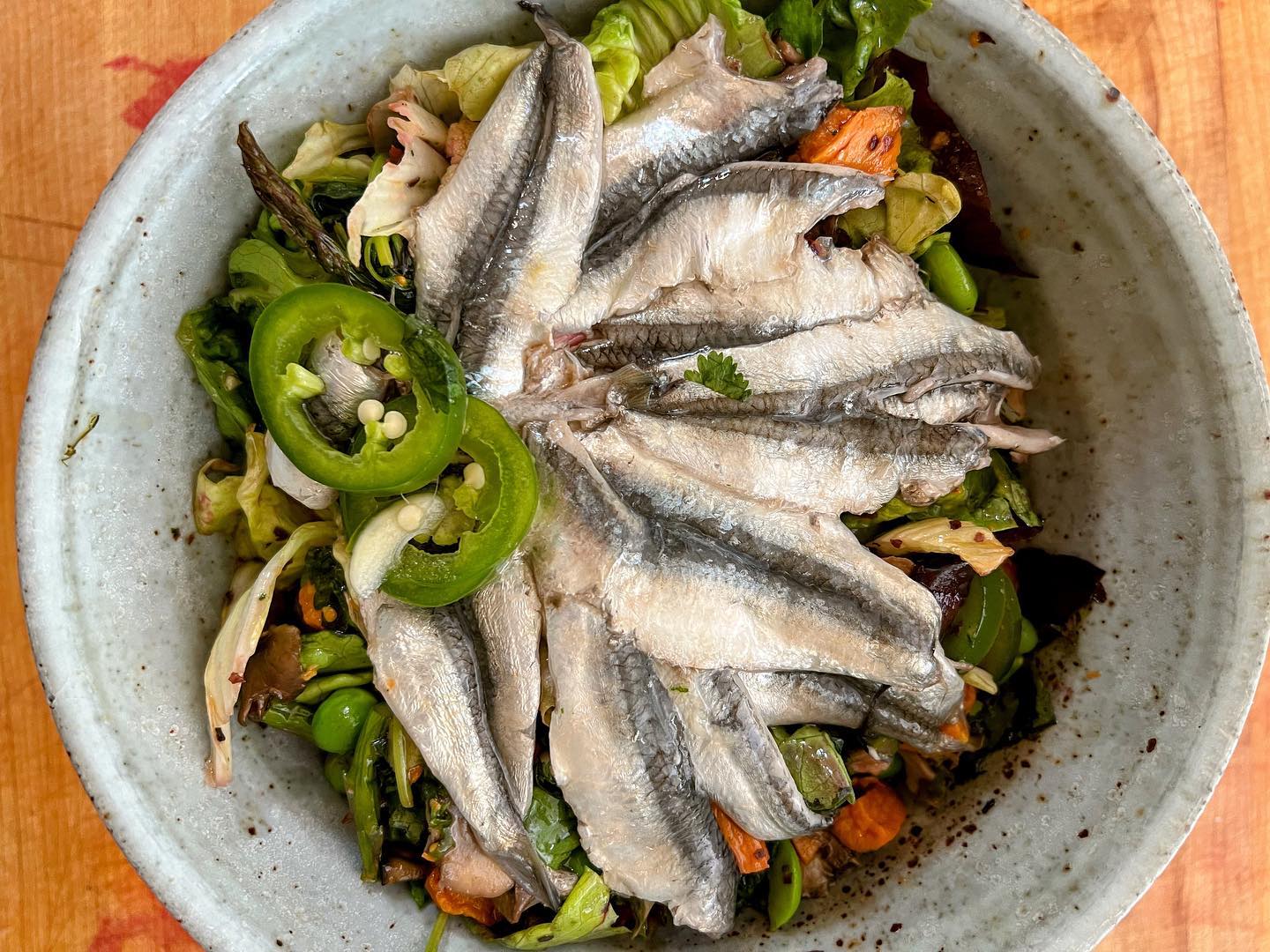
Vinegar-Cured Local Anchovies
A brief salting firms the delicate fish before vinegar turns the flesh opaque and pleasantly tart. Olive oil softens the acidity without obscuring the anchovies' fresh, marine flavor.
Ingredients
- 2 lb whole local anchovies, supplier-confirmed parasite-destruction frozen and thawed under refrigeration
- 20 g fine sea salt
- 2 cups white wine vinegar labeled 5% acidity, plus more if needed to cover
- 1/2 cup extra-virgin olive oil
Instructions
- Confirm that the fish have undergone a validated parasite-destruction freezing process suitable for raw service. Vinegar curing and salting do not reliably destroy parasites; do not use untreated fresh anchovies for this preparation.
- Keep the fish cold, working with a small batch at a time over a bowl set in ice. Remove the heads and guts, open each fish along the belly, and gently lift out the backbone and tail, leaving butterfly fillets. Remove any loose scales and visible bones. Rinse briefly with cold water only as needed and pat dry.
- Layer the cleaned fish in a nonreactive dish, distributing the salt evenly between layers. Refrigerate for 20 minutes, then drain and briefly rinse away excess salt. Pat dry.
- Place the fish in a shallow glass container and pour over enough cold vinegar to submerge them completely. Cover and refrigerate at 40°F or below for 4–6 hours, checking after 4 hours. The flesh should be opaque and firm but still supple; this is a texture cue, not a safety test.
- Drain well without squeezing. Transfer to a clean container, gently coat with the olive oil, cover, and refrigerate until serving.
Notes
- Buy from a trusted supplier and request fish specifically suitable for uncooked, cured preparations. Ordinary unmonitored home freezing is not a substitute for a validated process.
- Two pounds of whole anchovies should yield roughly 12–16 ounces of cleaned fish, depending on size and trimming.
- Keep refrigerated throughout and use within 48 hours after curing. Oil does not make the fish shelf-stable.
Quick-Pickled Jalapeños
Crisp pepper rings give the rich fish a sharp, green heat. A little garlic adds savoriness without turning the pickle into a competing sauce.
Ingredients
- 3 jalapeños, sliced into thin rings
- 1 small garlic clove, thinly sliced
- 1/2 cup white wine vinegar labeled 5% acidity
- 1/2 cup water
- 1 tsp fine sea salt
Instructions
- Place the jalapeño rings and garlic in a clean heatproof jar.
- Bring the vinegar, water, and salt just to a boil, stirring to dissolve the salt. Pour over the peppers, keeping them submerged.
- Let cool briefly, then refrigerate. Chill for at least 1 hour before serving; the peppers will become more rounded in flavor overnight.
Notes
- This is a refrigerator pickle, not a shelf-stable preserve. Keep refrigerated and use within 2 weeks.
- Use an existing batch of pickled jalapeños if available.
Roasted Carrots and Asparagus
Sweet browned carrots balance the tart fish, while asparagus adds a lightly charred, grassy note. Adding the asparagus later keeps it from becoming limp.
Ingredients
- 12 oz carrots, cut into 1/2-inch diagonal pieces
- 1 bunch asparagus, woody ends removed, stalks cut into 2-inch lengths
- 2 tbsp extra-virgin olive oil
- 1/2 tsp kosher salt, plus more to taste
- 1/4 tsp freshly ground black pepper
Instructions
- Heat the oven to 425°F. Toss the carrots with 1 tablespoon olive oil and half the salt and pepper. Spread on a large sheet pan and roast for 15 minutes.
- Toss the asparagus with the remaining oil, salt, and pepper. Turn the carrots and add the asparagus in a single layer, using another pan if needed to avoid crowding.
- Roast for another 10–15 minutes, until the carrots are browned and tender and the asparagus is bright green with lightly browned tips. Remove the asparagus earlier if slender.
- Let the vegetables cool to room temperature before adding them to the lettuce.
Fava and Mixed-Lettuce Salad
Tender greens and favas make a substantial but fresh bed for the anchovies. A restrained pickle-brine vinaigrette connects the vegetables to the jalapeño garnish without doubling down on vinegar.
Ingredients
- 1 cup shelled fresh fava beans, from approximately 1–1 1/2 pounds in their pods
- 6 oz mixed tender lettuces, washed and thoroughly dried
- 1/4 cup loosely packed cilantro leaves
- 3 tbsp extra-virgin olive oil
- 1 tbsp brine from the pickled jalapeños, plus more to taste
- 1/4 tsp crushed red pepper flakes
- to taste kosher salt
Instructions
- Bring a small saucepan of water to a boil and prepare an ice bath. Blanch the shelled favas for 2–3 minutes, until just tender, then transfer to the ice bath.
- Drain and slip the favas out of their pale outer skins. Dry well.
- Whisk the olive oil, pickle brine, and red pepper flakes in a large bowl. Taste before adding salt, since the brine and anchovies are already salty.
- Just before serving, gently toss the lettuces, favas, cilantro, and cooled roasted vegetables with the dressing. Add a little more brine only if needed; the anchovies will supply additional acidity.
Notes
- For a simpler preparation, use thawed, peeled frozen favas and blanch only until tender.
Overall Timing / Workflow
Complete the cold curing ahead of the vegetable work so the salad can be assembled quickly and served with properly chilled fish.
Instructions
- The day before, confirm the anchovies' parasite-destruction treatment and thaw them in the refrigerator if needed. Make the jalapeño pickles.
- About 6–8 hours before serving, clean, salt, and begin vinegar-curing the anchovies. Keep all fish work refrigerated or over ice.
- About 45 minutes before serving, roast the carrots and asparagus. Meanwhile, blanch and peel the favas, wash and dry the greens, and mix the dressing.
- When the fish reach the desired cured texture, drain and coat with olive oil, then return to the refrigerator.
- At serving time, dress the salad, arrange the chilled anchovies over it, and finish with drained jalapeño rings.
Plating
A broad, shallow bowl exposes the silvery fish while keeping the contrasting vegetables in every serving.
Instructions
- Divide the dressed vegetable salad among four shallow bowls, keeping some carrots, asparagus tips, and favas visible around the edges.
- Lift the anchovies from their oil and arrange them loosely over the salad, skin-side up and slightly overlapping.
- Add a few drained jalapeño rings and pickled garlic slices to each bowl. Spoon a little of the anchovy olive oil over the fish if they need extra gloss.
- Serve immediately, with the fish cold and the roasted vegetables cool or at room temperature.
Leftover Path
Separate storage preserves the fish's delicate texture and prevents the greens from becoming waterlogged.
Instructions
- Refrigerate unused anchovies promptly in a clean covered container with their oil and use within 48 hours of completing the cure.
- Store undressed lettuce separately from the cooked vegetables. Refrigerate cooked vegetables and favas for up to 3 days.
- Use remaining anchovies and vegetables in another freshly dressed salad. Eat already dressed salad the same day.
- Keep the jalapeños refrigerated in their brine for up to 2 weeks. Discard any fish or assembled salad left at room temperature for more than 2 hours, or 1 hour above 90°F.